Holidays and absences
Plan your team's holidays, track each employee's leave balance, share the yearly holiday schedule and let payroll work out holiday pay and sick pay from the leave.
Holidays (under Pay Yourself) is where you record who is away and when: annual leave, sick certificates and other absences. Arvello uses the same records to work out each employee's holiday balance, the holiday pay and sick pay in a payroll run, and the days off that lower the social-tax minimum.
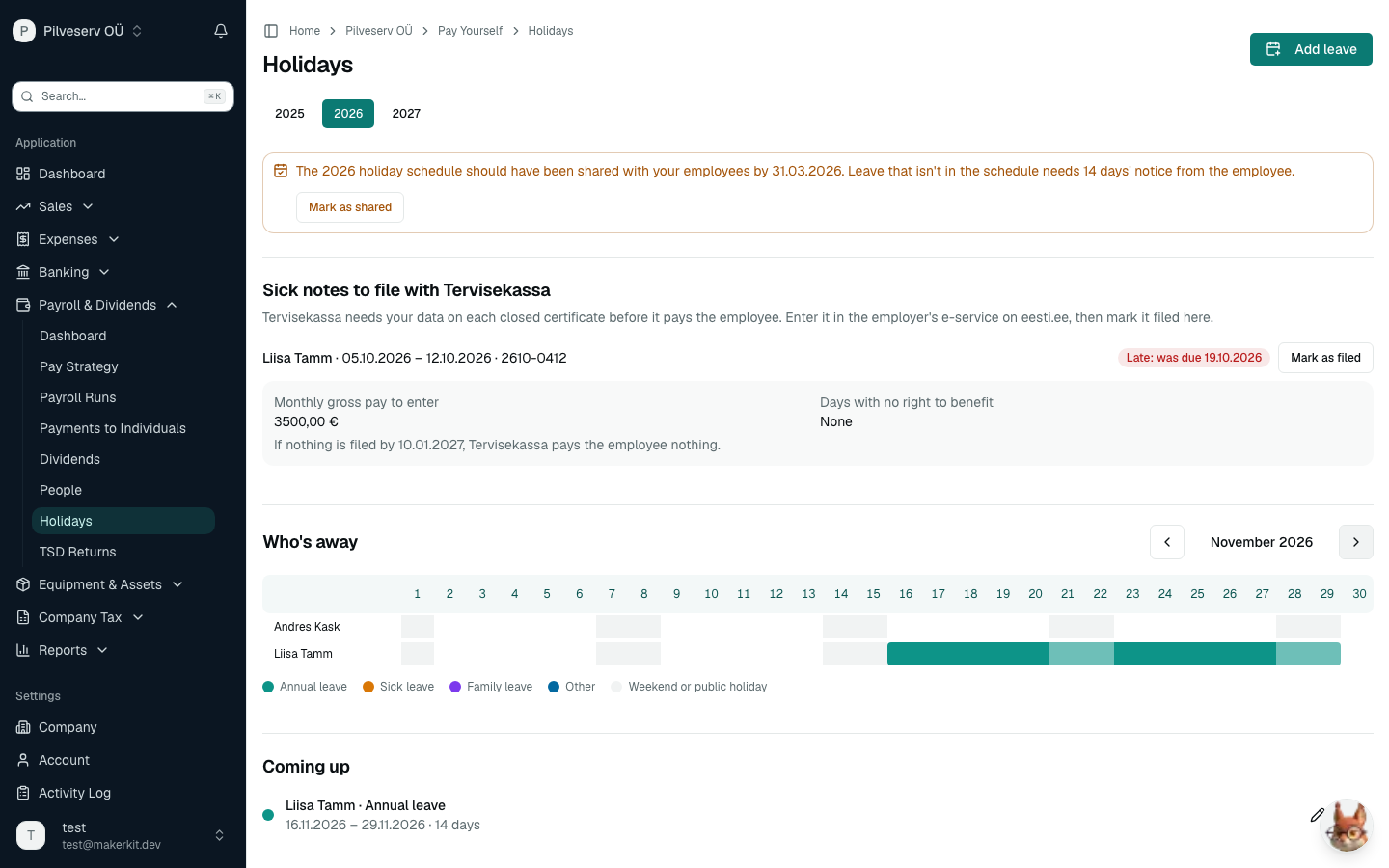
The planner
The planner shows one month at a time, with a row per person and a column per day. Weekends are shaded grey and Estonia's public holidays red, with the holiday's name when you point at it. Annual leave, sick leave and family leave each have their own colour. Click a day of leave to change or delete it, or click an empty day to add leave for that person starting on it. Under the planner, Coming up lists the next leave for everyone, and Public holidays lists the year's public holidays, with the next one marked. A public holiday inside a holiday isn't counted as an annual leave day.
To record leave, click Add leave, choose the person and the type, and enter the first and last day. The four types most companies use (annual leave, sick leave, unpaid leave and other absence) are at the top of the list, with family leave and the other statutory leave grouped below. The dialog shows how many days the leave takes up:
- Annual leave counts calendar days, but a public holiday inside it is never counted as a leave day. A holiday from 14 to 27 August 2027 is 13 days, because 20 August is a public holiday.
- Child leave, the disabled child's parent's leave and care leave count working days.
- Everything else counts calendar days.
Annual leave can start in the afternoon and end at lunchtime. Under the first day choose Morning or Afternoon, and under the last day End of day or Lunchtime. Each half is half a day: a holiday from Wednesday afternoon to Friday lunchtime is 2 days. A morning off is one day ending at lunchtime, and an afternoon off one day starting in the afternoon. The choice appears only on a working day. A half day takes 0.5 days off the balance, the salary row pays the half worked and holiday pay covers the other half. The law counts annual leave in calendar days and doesn't mention half days, so a half day is something you agree with the employee. Half days don't lower the social-tax minimum and don't count towards the 14-day block.
Board members have no statutory annual leave: the Employment Contracts Act doesn't apply to them. You can still record when they're away, with the type Other absence. For an employee, Other absence is unpaid: the run pays no salary for its working days.
Holiday balances
Each employee earns 28 calendar days of annual leave a year, or more if their contract says so. Minors and people with reduced work capacity get 35. You set the figure under Holiday settings on the person's page.
- In the year someone starts or leaves, they earn a share for the days they're employed. Someone who starts on 1 March earns 28 × 306 ÷ 365 = 23.47 days that year.
- Days on sick leave or holiday still earn leave. Parental leave and agreed unpaid leave don't.
- Days taken come out of the oldest year first.
- A year's leave expires one year after the end of the year it was earned for. So leave earned in 2025 must be used by 31 December 2026. Maternity, paternity, adoption and parental leave push that date back.
- Leave can't be paid out in money while someone is employed. When they leave, unused leave that hasn't expired is paid out.
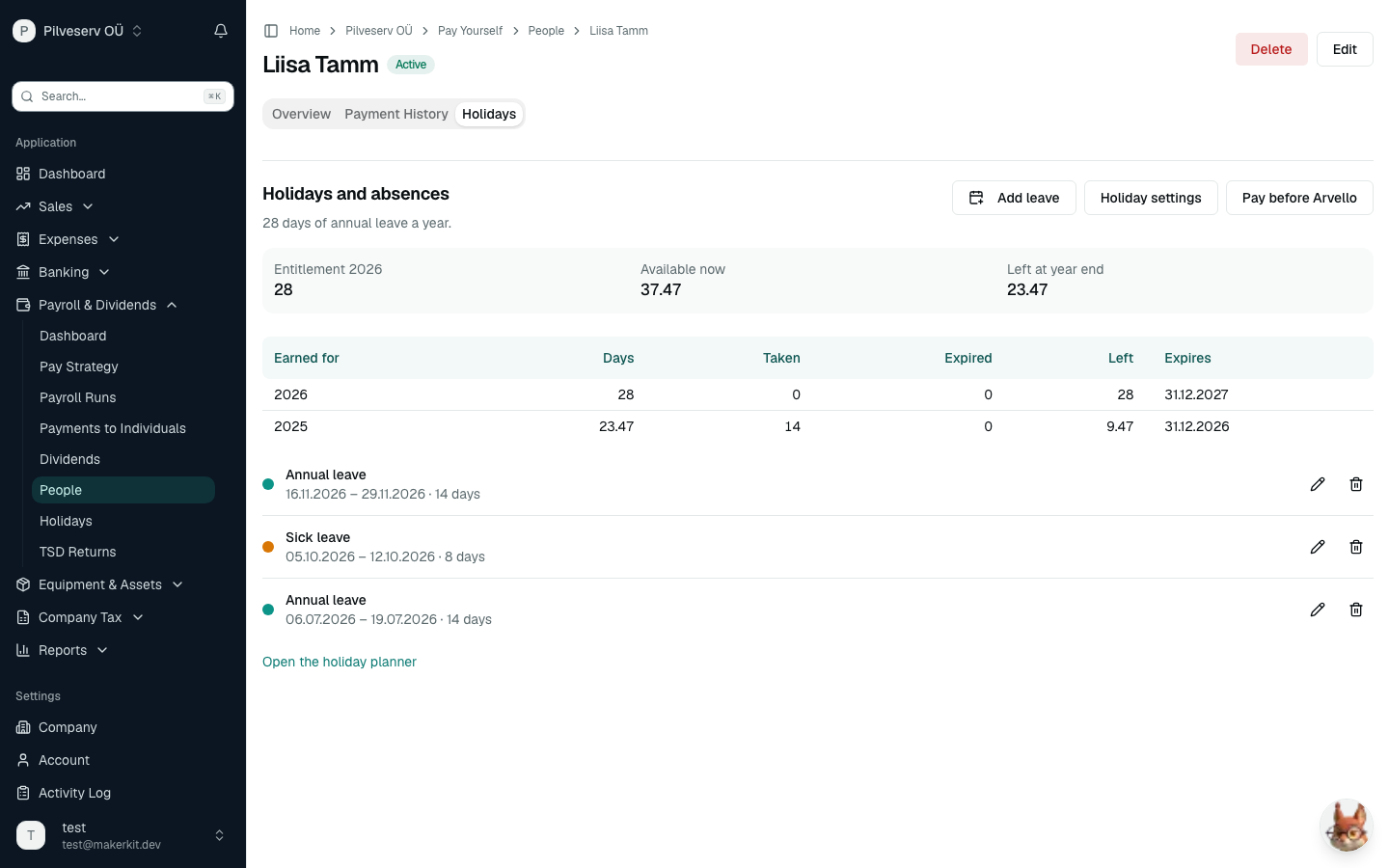
The Holiday balances table shows each employee's entitlement for the year, the days taken and planned, what is available now and what will be left at the year end. It flags days that are about to expire, and anyone without a block of at least 14 days in a row planned for the year: the law asks for one.
If an employee started before you tracked their leave in Arvello, open their page, choose Holiday settings, tick Carry in unused leave and enter the unused days on 1 January of the year you start. Arvello counts from that date.
The holiday schedule
The employer draws up a holiday schedule (puhkuste ajakava) for each calendar year and makes it known to the employees within the first quarter, so by 31 March. The leave planned in Arvello is the schedule: share it with your employees by email or on a notice board, then click Mark as shared and enter the date. Until you do, the page reminds you. Leave that isn't in the schedule needs 14 days' notice from the employee.
Holiday pay in a payroll run
When you create a payroll run, Arvello looks at the leave in the run's month:
- The salary row pays for the working days the employee wasn't on leave. With 9 working days of holiday in a month of 21, a €1,800 salary becomes €1,028.57.
- A holiday pay row is added for each unpaid holiday whose pay falls due in the month: the second-to-last working day before the holiday. A holiday starting on 2 November is paid with October's pay. A holiday whose pay fell due in the two months before and is still unpaid is offered too. The row pays the whole holiday at once. A holiday that runs past the employment's end (an end date recorded after the holiday was planned) isn't paid: the run asks you to correct its dates, and unused leave on leaving is paid as compensation instead.
- The Days off (TLS § 19) box is filled in from the leave, so the social-tax minimum is lowered for the days away. Agreed unpaid leave doesn't lower it.
Holiday pay is worked out in one of two ways:
| When | Holiday pay |
|---|---|
| The last six months were paid only the agreed salary, unchanged | The salary is kept: salary × the holiday's working days in the month ÷ the month's working days. For the August 2027 example, €1,800 × 9 ÷ 21 = €771.43, so salary and holiday pay still add up to €1,800. |
| Pay varied (a bonus, overtime, a change of salary) | Average pay: the pay earned in the six months before, divided by their calendar days less days away and public holidays, times the holiday's days. €12,000 over 174 days is €68.97 a day, and 13 days come to €896.61. |
Arvello takes the salary as unchanged when each of the six months paid exactly the agreed salary for the days worked, with no bonus. A change of salary in those months means average pay. Arvello can't always tell from the books whether a salary was fixed, so each holiday pay row has a link to switch to the other method. The row also shows the dates and the days paid, and you can edit the amount like any other row.
Holiday pay is due by the second-to-last working day before the holiday starts, unless you've agreed with the employee to pay it on the first payday after the holiday. If the run's payment date is later than that, the row warns you. Holiday pay is taxed like salary: TSD payment type 10 (120 for a non-resident).
If a company started using Arvello part-way through a year, average pay needs the months before. Open the person's page, choose Pay before Arvello and enter the gross pay for work, the days away (and how many of them were public holidays) and whether there was a bonus for each of those months. Until those months are there, a holiday keeps the salary and the run says pay before Arvello is missing; sick pay waits for them.
If an employee was paid nothing for more than twelve months (back from a long parental leave, say), the agreed pay is indexed by the rise in the minimum wage (regulation nr 91 § 2 lg 5), unless it is above the national average gross wage or set by a collective agreement. Arvello doesn't work that out. When there was no pay in the six months before the leave, and none Arvello knows of in the six before those, the run says so and you add the holiday pay or sick pay by hand.
Sick leave and Tervisekassa
Record each sick certificate (e-töövõimetusleht) as Sick leave, with its number and, once the doctor has closed it, the closing date. A continuation certificate (järgleht) is linked to the one before, so your days 4–8 are counted from the start of the first. If the employee was on holiday when they fell ill, tick The employee interrupted their holiday for this: the sick days come out of the holiday and go back to the balance. If the certificate covers all of a holiday that was already paid, the holiday is cancelled: its days go back to the balance, and you settle the holiday pay in a later run.
Days on any leave the employee didn't interrupt (a holiday, unpaid leave, study leave) carry no right to sick benefit (RaKS § 60 lg 4). You pay nothing for them in days 4–8, and they're listed for Tervisekassa.
The payroll run then adds a sick pay row for your days 4–8 at 70% of the average pay, the same way Add sick pay does (see Sick pay).
The doctor sends the certificate to Tervisekassa (the Health Insurance Fund), which emails you when it's opened and when it's closed. After the doctor closes it you have 7 days to add your data in Tervisekassa's employer e-service on eesti.ee. If nothing is added by the 90th day, Tervisekassa pays the employee nothing for it. Sick notes to file with Tervisekassa lists every closed certificate still waiting, with what to enter: the monthly gross pay and the days the employee was on leave, which have no right to benefit. When you've filed it, click Mark as filed. Arvello can't file it for you yet.
Other leave
| Leave | Who pays |
|---|---|
| Study leave | You: 20 days a year at the average pay, plus 15 days to finish formal studies at the minimum wage |
| Care leave | You, at the minimum wage, up to 5 working days a year for each adult cared for; the state pays it back |
| Child leave, disabled child's parent's leave | Sotsiaalkindlustusamet |
| Paternity, maternity, adoption, parental leave | Sotsiaalkindlustusamet |
| Unpaid leave | No one |
Sotsiaalkindlustusamet pays the family leave and keeps count of the days used, so Arvello records their dates for the planner and the register but keeps no tally of benefit days.
Study leave
When you add study leave, choose what it's for, as the employee's application says (TäKS § 13 lg 5):
- Studies or training: formal study or work-related training. Up to 30 calendar days a year; the first 20 in a calendar year are paid at the average pay, the rest are unpaid. Public holidays count as study leave days, and the average keeps them in its days too. €12,000 over 183 days is €65.57 a day, so 5 days come to €327.85. The salary is never simply kept, even if it's fixed.
- Finishing formal studies: 15 more days, given once, paid at the minimum wage: the minimum wage ÷ (the year's days ÷ 12). With €946 in 2026 that's €31.10 a day.
The payroll run adds a holiday pay row for study leave the same way as for a holiday, due before it starts. Study and care leave are paid from each calendar year's own days, so one that runs over New Year isn't worked out: end it on 31 December and add the rest as a new leave. It's taxed like holiday pay: TSD payment type 10.
Care leave
Care leave (hoolduspuhkus) is paid at the minimum wage: each working day of it × the minimum wage ÷ (the year's working days ÷ 12). In 2026 that's €42.19 a day to 31 March and €45.05 from 1 April. The payroll run adds the row for you, for up to 5 working days a year: that's the allowance for one adult cared for. If the employee cares for a second adult, the run says so and you add the pay for the extra days by hand. It carries income tax only, no social tax, unemployment insurance or funded pension, and goes on the TSD as payment type 16. Arvello declares it for residents only: for a non-resident, the run says so and you pay and declare it in e-MTA.
The state pays care-leave pay back. Apply to Sotsiaalkindlustusamet within three months of the month of the leave: a leave in March must be claimed by 30 June, and a later application is refused. To do outside Arvello on the holidays page lists the care-leave pay you've paid and not yet claimed, with the amount and the last day. Click Mark applied once you've sent it. When the money arrives, categorise it in banking like any other income.
The employment register
Parental leave, and unpaid leave that covers a whole calendar month, must be entered in the employment register (töötamise register) in e-MTA as a suspension, within 10 days of the start. To do outside Arvello lists them with the day they're due, counting the first day of the leave. Click Mark entered once you've done it. If you change the leave's dates afterwards, it comes back on the list: update the entry in e-MTA too. Sotsiaalkindlustusamet enters maternity and paternity leave itself, and annual, child, care and study leave aren't entered at all.
The year end
The annual report's year-end checks ask for the holiday pay owed for unused leave at the end of the financial year. Arvello starts the answer from the holiday balances: each employee's unused days × their average day's pay. Change it if you know better before you book it. Once you've answered, the check still shows what the balances give now: if leave or pay changes later, change the answer.
The rules are in the Employment Contracts Act (TLS §§ 54–71, holiday pay § 29 lg 8 and § 70), Government regulation nr 91 on average pay, the Adult Education Act (TäKS § 13), the regulation on state-reimbursed leave pay (tervise- ja tööministri määrus nr 62) and the Health Insurance Act (RaKS § 53). Official text: Töölepingu seadus, Keskmise töötasu maksmise tingimused ja kord, Täiskasvanute koolituse seadus, Riigieelarvest hüvitatava puhkusetasu maksmise kord, Ravikindlustuse seadus, Tervisekassa: töövõimetuslehed tööandjale.