Payments to individuals
Pay a private person for services, rent, a licence or loan interest from your OÜ: Arvello withholds income tax (22% in 2026), posts it and adds it to the TSD.
When your company pays a private person, Estonian law usually makes the company the tax collector: it withholds income tax from the payment, pays the person the rest, and declares the payment on the TSD, the monthly income and social tax declaration. That applies to fees for work or services under a contract, rent, licence fees and interest on a loan, including payments to the company's own founder. The exception is a registered sole trader (FIE) paid business income (see below). Payroll & Dividends → Payments to Individuals records these payments.
What counts
| Payment | Example | Taxes | TSD payment type |
|---|---|---|---|
| Work or services under a VÕS contract | A designer or consultant on a contract for services (töövõtu- or käsundusleping) | Income tax, social tax, unemployment insurance, funded pension | 17 |
| Rent | An office, car or equipment rented from a person | Income tax | 50 |
| Rent for a home | A flat or house let under a residential lease | Income tax | 57 |
| Licence fee or royalty | A licence to use an existing photo, font, software or design (work made to your order is a fee for services, type 17) | Income tax | 50 |
| Interest on a loan | Interest on a founder's loan to the company | Income tax | 54 |
The legal basis is the Income Tax Act (§ 41 points 3, 4 and 7) for the withholding, the Social Tax Act (§ 2(1) point 6), the Unemployment Insurance Act (§ 3) and the Funded Pensions Act (§ 7) for the extra charges on contract work. Rent, licence fees and interest are passive income and carry income tax only.
Before you start: the person
The person needs to be in People with their Estonian personal ID code, which the TSD declares the payment under. A founder who is already a board member or shareholder needs no new role. For a landlord, a lender or a contractor with no other role, tick Other payee on the person form. An other payee doesn't count towards your plan's people limit.
If the person has given your company a written application for the basic exemption, switch on Applies basic exemption for them. The exemption is shared with any salary or board fee the company pays them in the same month (in 2026 up to €700 a month, or up to €776 for the whole calendar year in which the person reaches old-age pension age; set that up in People as described there), and is deducted before the tax is withheld (Income Tax Act § 42).
For a fee for work or services, also set the person's II pillar funded pension rate under Tax Settings if they have joined the II pillar (check their pension register entry): the company withholds it from the fee (Funded Pensions Act § 11), and without a rate nothing is withheld. Someone working for you under a VÕS contract must also be registered in EMTA's Employment Register before the work starts, as an employee would be.
Recording a payment
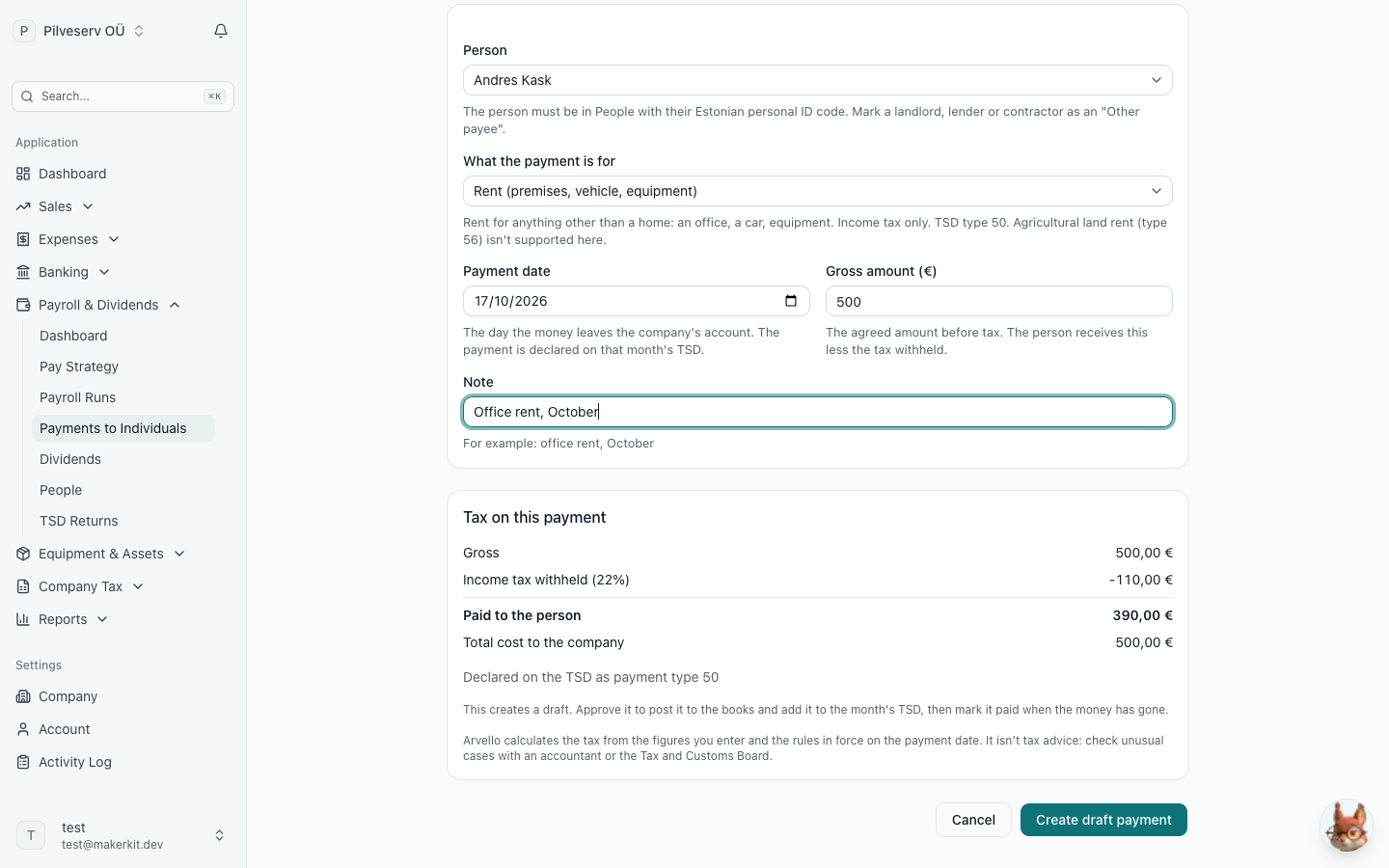
Go to Payroll & Dividends → Payments to Individuals and press New payment.
Choose the person and what the payment is for, then enter the planned payment date (the tax is worked out with the rules in force on it; you record the actual date once the money has gone) and the gross amount: the agreed amount before tax. For rent, enter the rent only: running costs such as utilities (VÕS § 292) and charges on the property such as land tax (§ 293) that the company pays or reimburses aren't rental income (Income Tax Act § 16(1)), so enter those as an expense. If the payment is for another month than the one it is due to be paid in, such as October rent paid in November, set For month. It can be the month it is due to be paid in or up to 12 months earlier, not later. Rent paid in advance leaves it empty and is booked when it is paid, like any expense the company pays in advance; Arvello doesn't move it to prepaid expenses month by month. A note such as "office rent, October" helps later.
Under Does any of these apply? the form lists the facts that change how this type of payment is taxed (see What isn't supported below). Tick one only if it applies: the payment then can't be recorded here, and the form says where it goes instead.
The form shows the tax as you type: income tax withheld, any unemployment insurance and pension withheld, the amount the person receives, and for contract work the social tax and unemployment insurance the company pays on top.
Create draft payment saves it as a draft you can still delete. Approve payment posts it to the books. Pay the person the net amount, then use Record payment on the payment's page with the date the money actually left: that date, not the planned one, decides which month's TSD the payment goes on (see Recording payments). The tax stays as calculated for the planned date. When the transfer appears in Banking, reconcile it as a Salary / Board Fee Payment to the person, which clears the net amount the company owed them. The person needs a recorded II pillar register check before a service fee can be approved (see People).
Each payment is its own record, so you can make as many in a month as you need.
A €1,000 fee to a designer under a contract for services, who has joined the funded pension at 2% and applied no exemption: unemployment insurance withheld €16 (1.6%), pension €20, income tax €212.08 (22% of €1,000 − €16 − €20). The designer receives €751.92. The company also pays social tax of €330 (33%) and unemployment insurance of €8 (0.8%), so the payment costs it €1,338.
In the books and on the TSD
On approval Arvello posts the gross amount as an expense dated the last day of the month the payment is for (the payment month, unless you set For month), as a payroll run is dated the last day of its pay period. October rent paid in November is therefore an October cost, owed at the end of October. Where that month ends on or before your opening-balance date, or falls in a year whose annual report is marked submitted or locked, the entry is dated the payment date instead. The accounts: contract work to salary expense (5200, a labour cost like a salary), rent to rent expense (5300), interest to interest expense (6000) and licence fees to operating expenses (5100). The net amount goes to net pay payable (2270), withheld income tax to income tax payable (2230), and for contract work the social tax, unemployment insurance and pension to their own payable accounts, exactly as for a payroll run.
The payment then appears on the TSD for the month it is paid, among the payments to residents, with its payment type: 17, 50, 54 or 57. The tax is part of the return's total. If you record it as paid in a month whose TSD you have already submitted, Arvello tells you but can't change that return: file an amended TSD for that month in e-MTA.
What isn't supported
- People who aren't Estonian tax residents. Their rates depend on the payment type (22% on rent from Estonian property, 10% on licence fees, and interest is usually not taxed at all) and can be cut by a tax treaty. Arvello refuses these payments; declare them in e-MTA.
- Payments dated before 2026. The basic exemption then depended on the person's income for the month, which separate payments can't share correctly. Payments from those years were declared before you used Arvello; correct them in e-MTA if needed.
- A registered sole trader's business income. Nothing is withheld (Income Tax Act § 40(2) point 3): enter their invoice as an expense.
- A fee for work or services to a registered sole trader that isn't business income. It carries no unemployment insurance (Unemployment Insurance Act § 3(2) point 1), which Arvello doesn't model: declare it in e-MTA.
- A fee paid into the person's entrepreneurship account (ettevõtluskonto). Their bank taxes it under the Simplified Business Income Taxation Act, and the company declares it on TSD Annex 6 (code 6080) and pays income tax on it (Income Tax Act § 34 point 13). Enter the payment as an expense and declare it in e-MTA.
- Contract work by someone with an A1 certificate from another EU/EEA country or Switzerland. Their social security is paid in that country: only income tax is withheld, and the payment is declared as TSD type 20. Declare it in e-MTA.
- Agricultural land rent (TSD type 56) and other passive income types not listed above.
- Interest the lender earned through an investment account. Nothing is withheld from interest earned on money held in an investment account (investeerimiskonto), or on a qualifying financial asset bought with it such as a loan made through a crowdfunding platform (Income Tax Act § 40(2) point 4, § 17¹(2)), when the lender has told the company so; it is taxed under the investment-account rules instead. Enter such interest as an expense. A loan the person made to the company directly is not such an asset, even if the money came from their investment account: its interest has tax withheld as usual.
Each of these is a box on the form; ticking one stops the payment from being recorded here.
- Repaying a loan. Only the interest is a payment here. The repayment of the loan itself has no tax and is matched in banking.
If you enter a purchase invoice from a supplier recorded as a private individual, or from an Estonian supplier with no registry code or VAT number, or book a line to rent or interest, the expense form points you here, but it doesn't block the save: buying goods from a private person, or paying rent to a company, is entered as an expense.