Dividends
Estonian OÜ dividend tax explained: corporate income tax at 22/78 on net distributions, calculated by Arvello with the shareholders' resolution generated.
Estonia famously charges 0% corporate income tax on profits you keep in the company. The tax arrives when profit leaves: distribute a dividend and the company pays corporate income tax (CIT) of 22/78 on the net amount handed to shareholders.
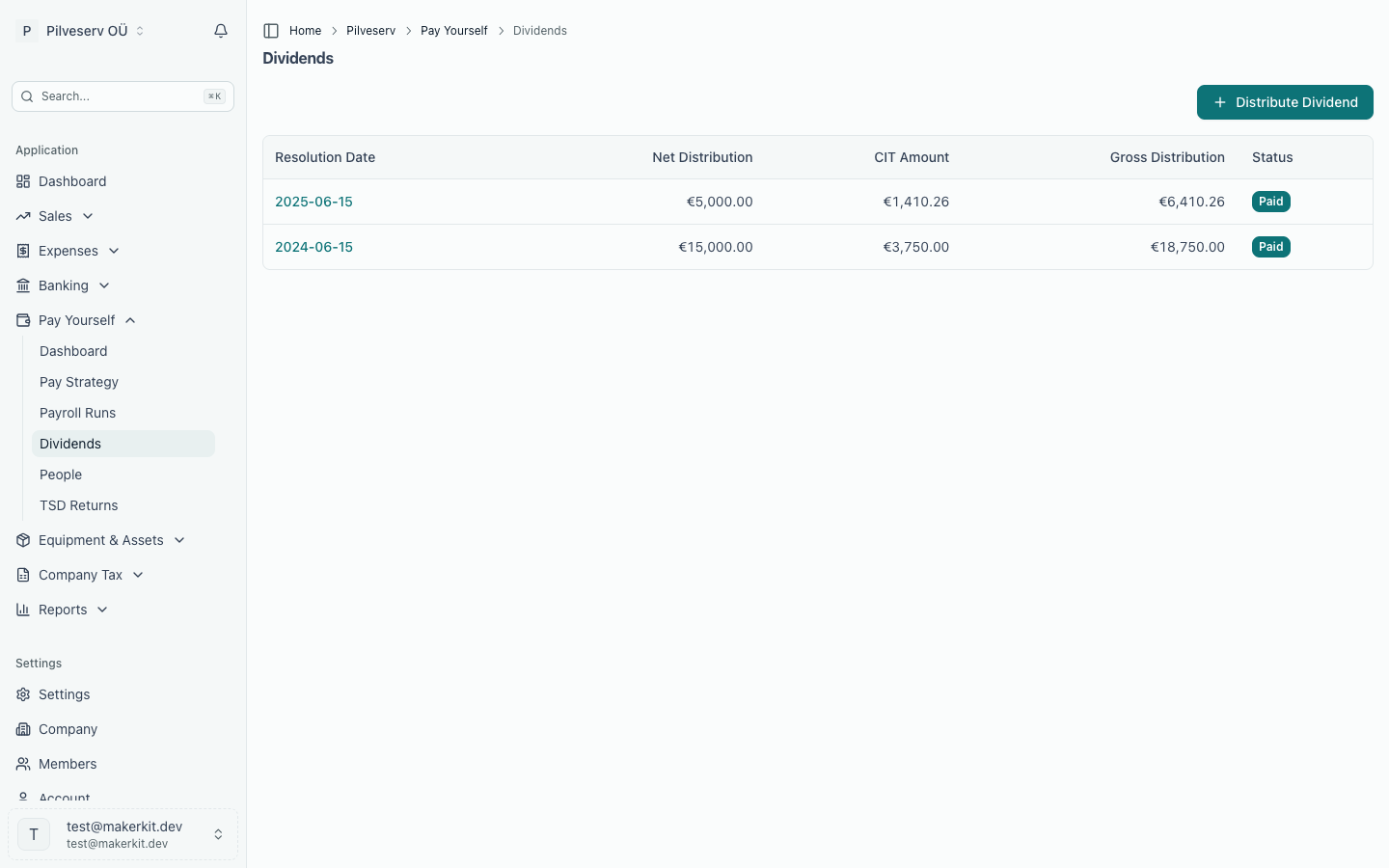
Arvello calculates the tax, checks you have profits to distribute, produces the shareholders' resolution document, and puts the distribution on the right month's TSD return.
What's available to distribute
Under Estonian law, dividends can only be paid from profits approved by the shareholders as part of an annual report. The Available for Distribution card on the Pay Yourself dashboard (Payroll & Dividends → Dashboard) therefore counts:
- Retained earnings from prior years, plus
- the profit from your last approved annual report, plus
- the profit of any financial year you have kept in Arvello and already filed — Arvello never posts a year-end closing entry, so that profit stays on your revenue and expense accounts rather than moving to retained earnings, but it is approved and it counts.
Profit that is not yet distributable is listed underneath in grey: your current year's running result, and any closed financial year whose annual report you have not filed yet. Arvello reminds you to file the report to unlock it. Every figure comes from your accounts, so the card adds up to the equity section of the balance sheet. Draft dividends awaiting approval are flagged too, since they'll eat into the same pot.
Distributions you have already made are subtracted automatically — a dividend journal entry reduces retained earnings — so the card never offers you the same profit twice. Two decisions from a filed annual report come off as well: profit allocated to reserves, and any dividend the resolution allocated that you have not declared yet, shown as Resolved, not yet declared. That money is spoken for, even though nothing has been paid or taxed.
From the annual report to a declared dividend
Filing your annual report records the shareholders' decision to pay a dividend. It does not pay one. Declaring it is a separate step, because a declaration needs things the report does not hold: who is paid, in what shares, and when — and it is the declaration that posts the journal entry and puts the corporate income tax on your TSD.
Arvello keeps the two joined, so a resolution cannot quietly go unpaid. While a filed resolution still has a dividend to declare, you will see it:
- on the annual report itself, as Declare the dividend;
- at the top of Payroll & Dividends → Dividends;
- on the Available for Distribution card, as Resolved, not yet declared.
Following any of them opens the dividend form with the resolved amount already filled in and tied to that resolution, so declaring it releases the amount the card was holding back. Declare only part of it now and Arvello keeps prompting for the rest.
The tax
CIT is 22/78 of the net distribution, paid by the company on top of what shareholders receive. You can enter either side and Arvello derives the other:
| You enter | Net to shareholders | CIT (22/78 of net) | Gross cost to company |
|---|---|---|---|
| €10,000 net | €10,000.00 | €2,820.51 | €12,820.51 |
| €10,000 gross | €7,800.00 | €2,200.00 | €10,000.00 |
No social tax applies, and since 2025 no further income tax is withheld on regularly taxed dividends paid to resident individuals — the 7% withholding disappeared along with the old reduced rate. (Non-resident shareholders can involve tax treaties; that's one for an advisor.)
Declaring a dividend
After approval you can Download Decision — a shareholders' resolution PDF in Estonian or English — and mark the distribution as paid once the transfers go out. Every distribution stays in the Dividends list with its resolution date, net, CIT and status, and appears on the following TSD as Annex 7 — see TSD returns.
Dividends versus salary or board fee
The trade-off cuts both ways, so here it is in full:
| Dividend | Salary / board fee | |
|---|---|---|
| Tax cost | CIT 22/78 of net — the lowest total tax cost of the payout routes | Income tax 22% + social tax 33% (+ unemployment insurance on salaries) |
| Social tax | None | 33%, employer-paid |
| Income tax withheld | None on regularly taxed dividends to resident individuals | 22% after any basic exemption |
| Health insurance cover | None — dividends alone leave you uninsured | Yes, via social tax |
| Pension / social-security record | None accrued | Accrues |
| Requires | Approved profits from an annual report | Cash and a payroll run |