Activity log
A permanent audit trail for your Estonian company books: creates, updates, finalisations and deletions, with who, when and from/to detail where captured.
Accounting runs on the question "who changed this, and when?" — and the activity log answers it without anyone having to remember. Actions on your company's main records leave a permanent entry: entries are written by the system as things happen, and nobody — not even an Owner — can edit or delete them afterwards.
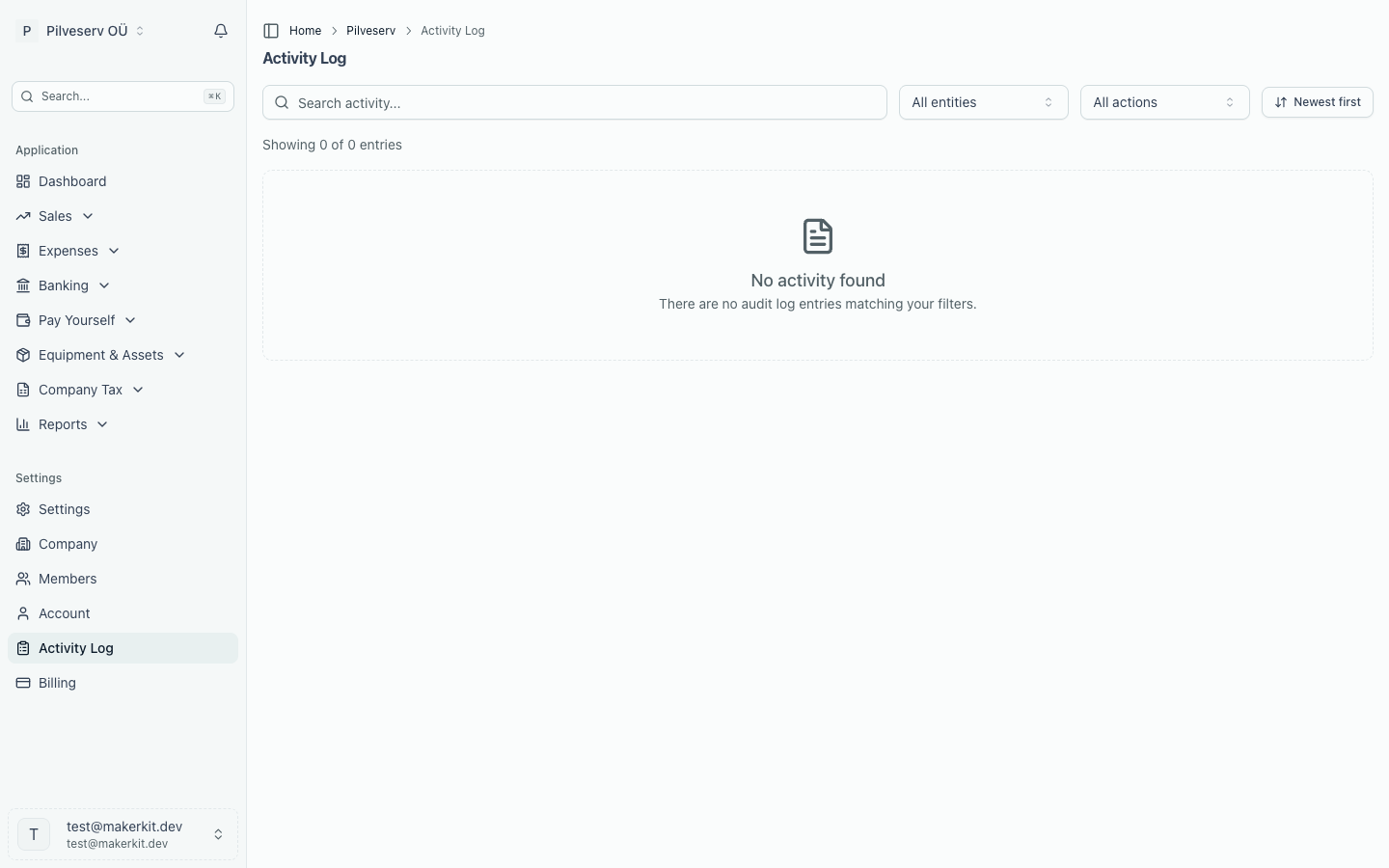
You'll find it under Activity Log in the Settings group of the sidebar.
What gets recorded
Each entry says who did it, what happened, and when. The what is an action on a record — created, updated, finalised, sent, paid, matched, reconciled, cancelled, reversed, deleted — across the things you work with: invoices and expenses, bank transactions and bank accounts, contacts, receipts, recurring templates, assets, payroll people, categorisation rules and journal entries. Entries are named in the language you use Arvello in, such as "Invoice finalised" or "Reconciled: tax payment to EMTA".
Filings and sign-offs are recorded too, each with the period and the amounts it covered: approving, reopening, filing and amending a VAT return (KMD), preparing and filing a TSD, EMTA accepting or rejecting a return, approving and paying a payroll run, recording, approving and paying a dividend, marking an annual report as filed, locking or unlocking a financial year, saving the profit distribution, saving opening balances and choosing where the books start, and changes to your company details, who files your tax returns, and your OSS and IOSS registrations.
Under each entry is who did it: the team member's name, Arvello, automatically when Arvello recorded something itself (such as EMTA's answer to a return sent through X-tee), or Former member when that person has since left the team.
Where an entry records what changed (updates to contacts, payroll people and bank accounts, for instance), expanding it shows each changed field with its From and To values, so "Contact updated" becomes "email changed from anna@example.ee to raamatupidamine@example.ee". Bank account numbers such as IBANs show only their last four characters, so a changed account is visible without printing the number, and personal identification codes are left out of this detail view.
Finding things
The page shows the most recent 500 entries, newest first, with three ways to narrow them down:
- Entity filter — only invoices, only bank transactions, and so on.
- Action filter — only deletions, only updates, whatever you're hunting.
- Search — free text across the entries, including the names they're shown with.
A sort toggle flips between newest-first and oldest-first when you're reconstructing a sequence of events.
What it's for
Mostly, answering questions calmly instead of forensically:
- Your accountant asks why a figure moved. Filter to the entity, find the update, read the from/to values, done.
- Two people work in the same books. The log shows which of you posted, paid or deleted what — useful information, delivered without an argument.
- Something looks off. An invoice you don't remember cancelling, a transaction recategorised — the log says who and when, which is usually the whole mystery solved.
- An audit trail exists by default. Estonian accounting expects records to be traceable; the log is that trace, kept for you automatically.