People
Add employees, board members and shareholders with the Estonian tax details the TSD declaration needs: ID code, basic exemption and II pillar pension rate.
Everyone your company pays — board members, employees and shareholders — lives under Payroll & Dividends → People. Arvello uses each person's details to calculate their payroll taxes correctly and to fill in the TSD, the monthly income and social tax declaration filed with EMTA (the Estonian Tax and Customs Board).
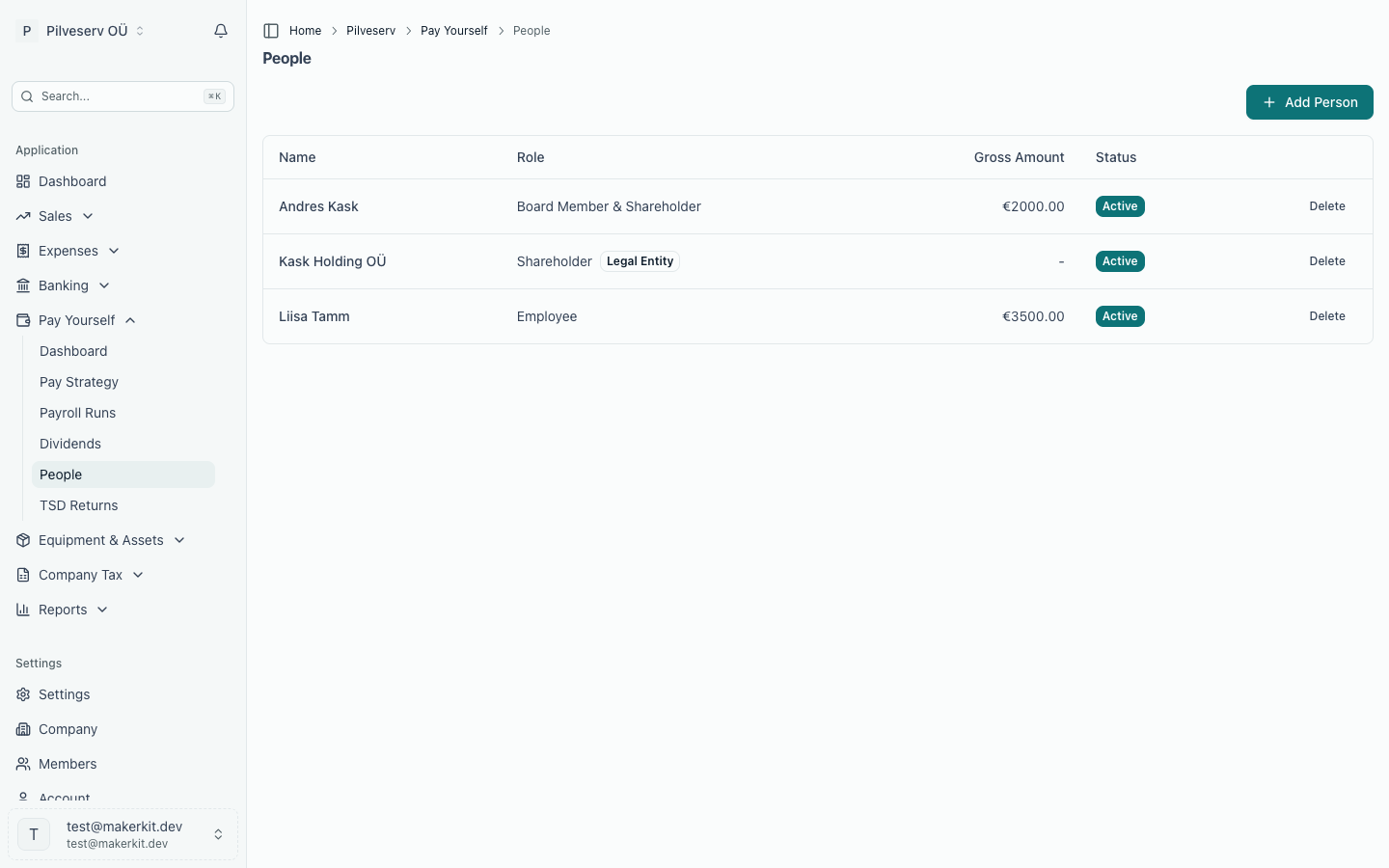
One person can hold several roles at once: a typical solo founder is board member and shareholder, and sometimes employee too.
The list shows each person's tax residency. For people imported from the Business Register it's set from their ID code, which isn't proof of where they live (an e-resident has an Estonian code but usually lives abroad), so check it before you pay anyone.
Adding a person
Click Add Person and fill in:
- Name — first and last name, or the legal name and registry code if the shareholder is a company (legal entities can only be shareholders)
- Personal ID code (isikukood) — the 11-digit Estonian identification code, required for Estonian residents and for TSD filing. A personal code issued by another country goes in Foreign Tax ID under Tax Settings instead (the field appears once Estonian tax resident is switched off), even when it looks the same: Lithuanian codes, for example, also have 11 digits
- Bank IBAN and bank name — where their net pay goes
- Email — used for emailing payslips
- Role(s) — board member (with a start date, and a monthly gross fee if they are paid one — the fee is optional), employee (with a monthly gross salary, start date, position and working time as a share of full time; the annual report counts employees as full-time equivalents, so a half-time employee is 50%), shareholder (with an ownership percentage), and Other payee for a private person the company pays only for work under a contract, rent, a licence or interest (see Payments to individuals). An other payee doesn't count towards your plan's people limit, and neither does a shareholder that is a company
Under Tax Settings you record what drives the calculation: whether they are an Estonian tax resident, whether they apply the basic exemption with your company (€700 per month in 2026 — a person can apply it with only one employer), their II pillar funded pension rate (2%, 4% or 6%, or not enrolled) with II pillar register checked on, and their payslip language — Estonian or English.
The law makes the payer check, by personal ID code, whether the person is in the II pillar and at what rate (Funded Pensions Act § 11), so the person's own word isn't enough. Arvello can't read the register yet: check it in e-MTA or at Pensionikeskus, set the rate, and enter the date you checked. Joining and leaving take effect on 1 January, 1 May or 1 September, and a rate change on 1 January, so a check covers payments up to the next of those dates. Arvello keeps one rate per person, so check again on or after each change date, before the first payment after it, and update the rate then: a check made in April can't cover May, or a rate entered for someone joining on 1 May would also apply to April's pay. A payroll run can't be approved while anyone in it who gets wages, a board fee or a service fee has no check covering the payment date — the run tells you who. If you change someone's personal ID code, Arvello clears the check date, since that check was made under the old code: check again under the new one and enter the date (in the same save, or later).
People imported from the Business Register during setup arrive with a default residency. A person is resident with an Estonian personal code, and otherwise non-resident with no country. A company shareholder is resident with an Estonian registry code, and otherwise non-resident. Check each person against the Income Tax Act's test (§ 6): someone is an Estonian tax resident if their place of residence is in Estonia, or if they stay in Estonia for at least 183 days within 12 consecutive months.
For a non-resident, also choose the country they live in: their payments record it and are declared under it, so Arvello won't calculate payroll for a non-resident without one. A non-resident shareholder who receives dividends also needs their Address in Country of Residence, and a Foreign Tax ID if they have no Estonian personal ID code: form INF 1 on the TSD declares them by these. The country also decides the basic exemption. A non-resident who lives in another EEA country (the EU, Iceland, Liechtenstein or Norway) gets it like an Estonian resident, once they have applied with your company and a valid certificate of tax residency from their home country is registered with EMTA. Record each certificate on the person's page under Residency certificates with Add certificate: the issuing country and the period it is valid for (usually 12 months unless the certificate says otherwise; check it in e-MTA with the non-residency inquiry). Arvello deducts the exemption only from payments dated within a certificate from the country the person lives in. When a certificate is renewed, add the new one: the old one stays on record, so earlier payments keep the certificate that covered them, and each payment records which certificate it relied on. Deleting a certificate entered by mistake recalculates draft runs that used it when they are approved. A certificate an approved payroll run relied on can't be deleted. If its period was entered too long, or the certificate was withdrawn, use End early and choose the first day it is no longer valid: payments dated from then get no exemption from it, while the approved ones keep it on record. You can't end it on or before an approved payment that relied on it, and the day can only be moved earlier later on. Without a certificate, nothing is deducted and the person can reclaim the exemption through an annual income tax return. A non-resident living anywhere else gets none, even with the box ticked (Income Tax Act § 42(1)). Each payroll payment keeps the residency it was calculated with. Changing it here affects draft payroll runs and future payments only: once a run is approved, its payments stay on the TSD annex they were paid under, even if the person later moves to or from Estonia. Correcting a wrong personal ID code, or removing one entered by mistake, is different. If the old code is on approved payments, Arvello asks you to confirm before saving, then corrects it on those payments too. Prepare the TSD return for those months again; a return you've already filed needs a correction. Only change the code to fix a mistake: if it belongs to a different person, add them as a new person. A foreign tax ID stays as it was on past payments, since it changes when someone moves country.
Two further settings cover special cases. If the person is reaching old-age pension age, switch that on and enter the date they reach it (shown in their pension information at sotsiaalkindlustusamet.ee): their basic exemption becomes the fixed pension-age amount (up to €776 per month in 2026, declared on the TSD with code 650 instead of 610) for the whole calendar year of that date, and employee unemployment insurance (1.6%) is withheld until the end of that month, then stops for payments made from the 1st of the next month. The employer's 0.8% continues. The Social Insurance Board applies the pension-age exemption to their pension first, so enter only the unused portion as the amount. If the person was granted an early or flexible old-age pension before reaching pension age, enter the date it was granted instead: employee unemployment insurance stops for payments made after that month, the employer's 0.8% continues, and the basic exemption stays the standard one. For employees there is also a minimum social tax setting: by default the employer owes social tax on at least the monthly base (€886 in 2026) even when the salary is lower, but if an exemption from the Social Tax Act applies — the person receives a state pension, raises a child under 3 or three or more children under 19, is a pupil or student, has reduced work ability, or the minimum is covered by another employer — mark them exempt and record the basis.
Employee or board member — the tax difference
Social tax of 33% applies to both, and both carry the II pillar contribution if the person has joined — it follows social tax, not the employment relationship. The difference is unemployment insurance: salaries carry 1.6% withheld from the employee and 0.8% paid by the employer, board member fees carry neither side.
The same €1,000 gross, paid each way in 2026 (resident, €700 basic exemption applied, not in the II pillar). The unemployment premium comes off before income tax is worked out, which is why the salary's tax is the lower of the two:
| Board fee | Salary | |
|---|---|---|
| Gross | €1,000.00 | €1,000.00 |
| Employee unemployment (1.6%) | — | €16.00 |
| Income tax (22% after exemption) | €66.00 | €62.48 |
| Net paid out | €934.00 | €921.52 |
| Social tax (33%, employer) | €330.00 | €330.00 |
| Employer unemployment (0.8%) | — | €8.00 |
| Total cost to company | €1,330.00 | €1,338.00 |
A 2% II pillar contribution would withhold a further €20.00 from each gross. It also comes off the income-tax base, so each net falls by €15.60 rather than €20.00 — to €918.40 and €905.92.
The board fee costs the company slightly less and pays out slightly more — but the person accrues no unemployment insurance entitlement from it.
What the TSD needs per person
Each payment appears as a row on the TSD with the person's ID code, name, a payment type code (salary, board fee, bonus and so on), the gross amount, basic exemption applied, and the income tax, social tax, unemployment insurance and pension figures — on Annex 1 for residents and Annex 2 for non-residents up to September 2026, and in the single Väljamaksed part from October 2026 (see TSD returns). A non-resident's row also carries their country of residence, and needs an Estonian personal ID code: without one, Arvello leaves the payment out of the file for you to add in e-MTA. Dividend recipients appear on Annex 7 with their ID code (or registry code for companies), net amount and ownership percentage, and on form INF 1, where a non-resident also needs a country, an address there and an ID code. Arvello leaves anyone without them out of the INF 1 file, and the return says how many. If a resident's ID code is missing, their salary and board fees can't be declared — hence the form nagging you for it.
Employee logins
On Growth and Business, a person can have their own login to see their payslips and pension contributions, ask for changes to their details, apply for the basic exemption and submit expense claims, business trips and mileage. You give it from the Employee portal section on their page, and changes they ask for wait there for your approval. See Employee logins.
When someone leaves
When a board member steps down, edit the person and set the Board Member Until date. That records the date, but doesn't take them out of payroll by itself: a new run still pre-fills everyone with a board fee or salary set. To stop paying a board member, set their monthly fee to 0 (a fee is optional), or remove their row on the run's payments step before you create the run. For an employee who leaves, remove their row the same way — the person form has no employment end date yet. Their payment history, payslips and past TSD entries stay exactly where they are. If they have an employee login, it stays until you remove it on their page, so they can still download their payslips.
You can also remove a person entirely, but this is permanent and only sensible for someone added by mistake — a person with payment, dividend or home office records is part of your accounting records, which must be kept for 7 years, so they stay on file.
A person's page also has Holidays and absences: their leave, the holiday balance by year, Holiday settings (the annual leave days and any unused days carried in) and Pay before Arvello for the average pay. See Holidays and absences.