Sick pay
Pay an employee's sick leave in an Arvello payroll run: the employer's days 4 to 8, the tax-free limit per sick day, and what is taxed as wages above it.
Sick pay is added to a payroll run with Add sick pay (see Running payroll). This page explains what the employer owes and how Arvello taxes it.
When an employee is on sick leave, the employer pays 70% of their average pay for the 4th to 8th calendar day. Nothing is owed for days 1–3, and from day 9 the Health Insurance Fund (Tervisekassa) pays sickness benefit. You can pay more than that if you choose: for days 1–3, above 70% for days 4–8, or on top of Tervisekassa's benefit from day 9.
All sick pay carries income tax. Part of it is also free of social tax, unemployment insurance and the II pillar contribution, up to a limit for each sick day:
| Sick days | Limit per day |
|---|---|
| Days 1–8 | 100% of average daily pay |
| Day 9 onwards | 30% of average daily pay (Tervisekassa pays 70%) |
Average daily pay is the wages the employee earned in the six calendar months before the month the sick leave began, divided by the calendar days in those months less the days they were away from work under TLS § 19 (holiday, sick leave and the like), which earned no wages. Anything you pay above the limit is taxed like salary.
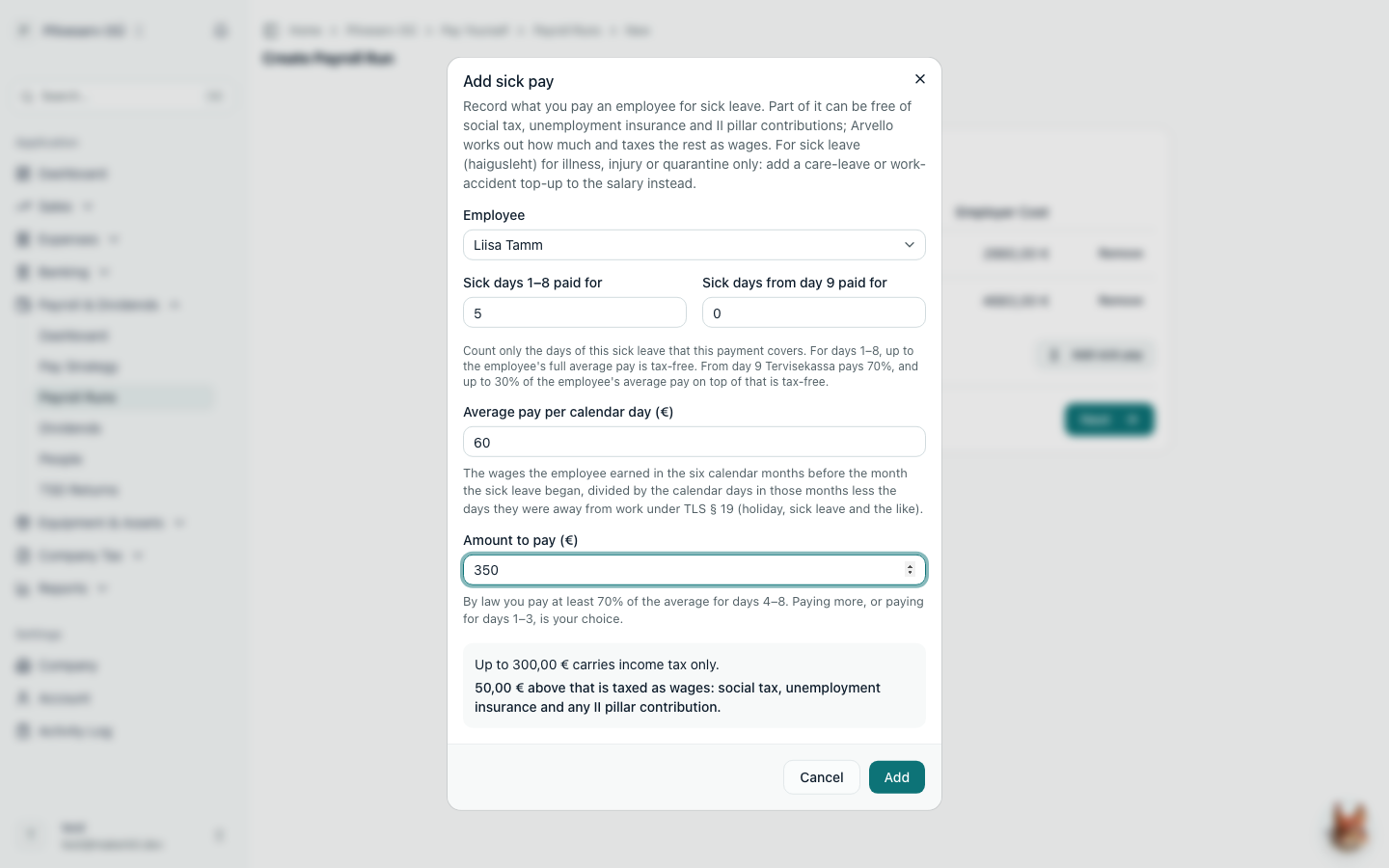
To record it, click Add sick pay on the payments step and enter:
- the employee;
- how many of the sick leave's days 1–8 this payment covers, and how many days from day 9;
- the average pay per calendar day;
- the amount you're paying.
The dialog shows the limit as you type. When the run is created, Arvello splits the payment there: up to the limit it's Sick Pay (Employer), TSD payment type 24 (129 for a non-resident), with income tax only. The rest is Sick Pay Above the Limit, payment type 10 (120 for a non-resident), with every payroll tax. A long sick leave paid over several months gets a row in each run, counting only the days that payment covers.
Take an employee whose average pay is €60 a day, off sick for 5 days, paid €350. The limit is 5 × €60 = €300, so €300 carries income tax only and €50 is taxed as salary. EMTA's own example: €30 a day and a 30-day sick leave give a limit of 8 × €30 + 22 × €30 × 30% = €438.
Add sick pay is for sick leave (haigusleht) for illness, injury or quarantine only. Not covered: a top-up to Tervisekassa's care-leave benefit (hooldusleht), where the limit is 20%; a work-accident or occupational-disease leave, where Tervisekassa pays from day 2; and from 2026 the extra top-up allowed when Tervisekassa caps a high earner's daily benefit. Add those top-ups to the salary row instead, where they're taxed as salary. For care leave and the high-earner cap that is more tax than the law requires, never less. Sick pay can be added for employees only, not for board members. The social-tax minimum is reduced in proportion to the days off sick: enter them as Days off (TLS § 19) on the employee's salary row, a €0.00 one included. If they were away for the whole month, no minimum is owed (see Minimum social tax above).
The rules are in the Occupational Health and Safety Act (TTOS § 12² and § 12³), the Social Tax Act (SMS § 3 p 3) and the Health Insurance Act (RaKS § 54); EMTA explains them on its page on income tax and the basic exemption. Official text: Occupational Health and Safety Act, Sotsiaalmaksuseadus, Ravikindlustuse seadus, EMTA: Tulumaks ja maksuvaba tulu.