Paying yourself
How to pay yourself from an Estonian OÜ — salary, board member fee or dividends — with payroll taxes calculated and the monthly TSD return prepared for you.
Money leaves an Estonian OÜ for its owner in three main ways: a salary, a board member fee, or a dividend. Each is taxed differently, and many founders use a combination. The Payroll & Dividends section (its dashboard is titled Pay Yourself) handles all three, along with the monthly TSD declaration — the combined income and social tax return filed with EMTA (the Estonian Tax and Customs Board) — that follows whenever you pay anyone.
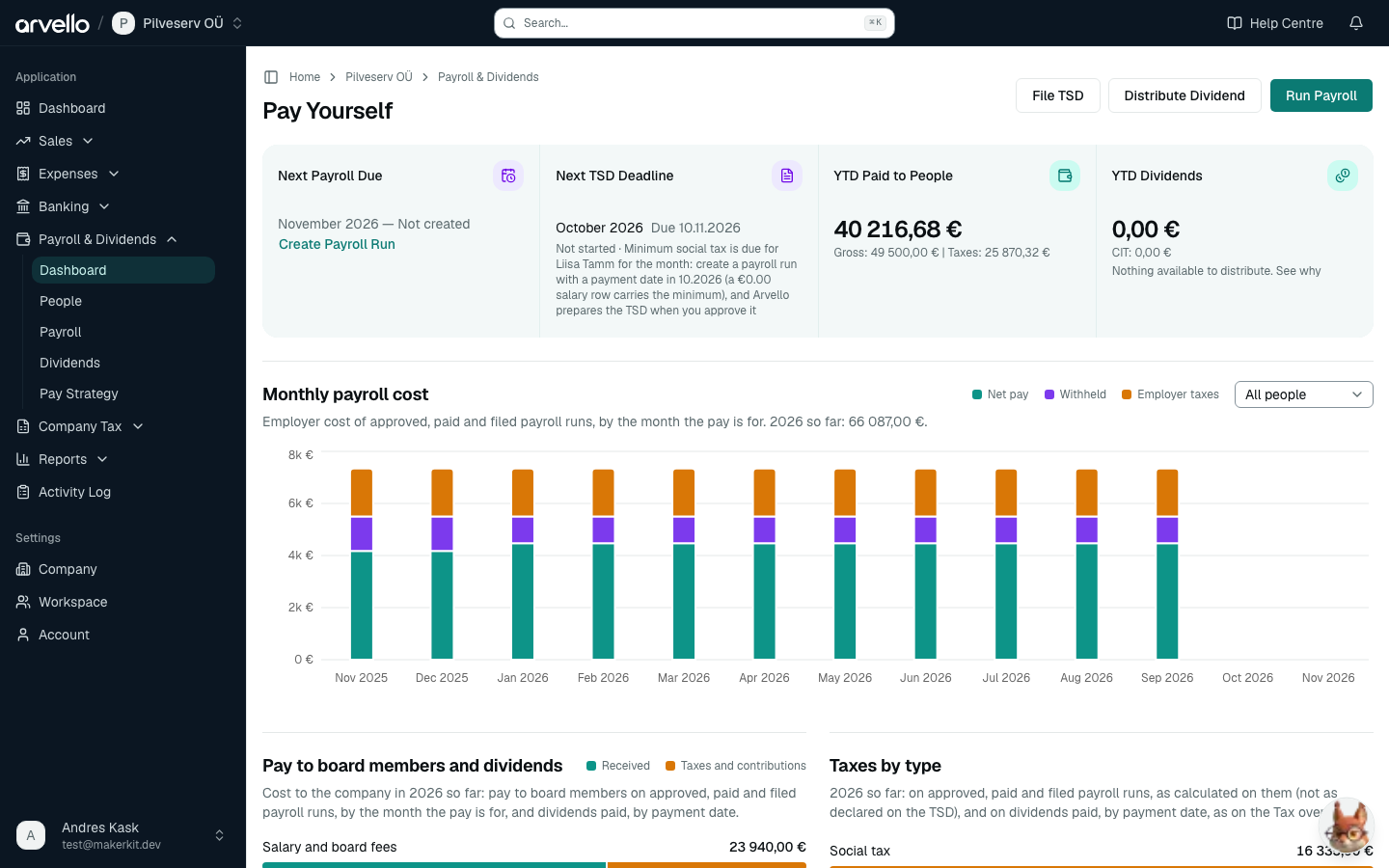
The dashboard
The figures at the top show the next payroll and TSD deadline, and what you've paid so far this year. Next Payroll Due asks for this month's run when someone needs one: an employee whose employment reaches this month (even with no salary set, since the minimum social tax is owed every month unless they're exempt), or a board member with a fixed monthly board fee whose term reaches it. Owners who take only dividends don't need a run, so it then says "No payroll due this month". Next TSD Deadline lists the returns not yet sent to EMTA, flagging one past its due date as overdue unless someone else files that month; with none, it shows the next TSD deadline and where that month stands, as on the dashboard. A past month with something waiting to be declared and no return yet (costs for Annex 5 or 6, or a staff meal, gift or event) is listed first, flagged overdue, as on the dashboard. YTD Paid to People counts approved, paid and filed payroll runs for this year's months up to the current one, by the month the pay is for: net pay as the headline, with the gross and the taxes (everything withheld plus the employer's taxes) under it. YTD Dividends counts the dividends paid this year, by their payment date, with the corporate income tax on them as the Tax overview counts it: each month's payments taxed on their total, allowing for any part paid out of dividends the company itself received. An approved dividend you haven't recorded as paid isn't counted yet. Under it is how much the company may distribute now; select it for the full breakdown on the Dividends page.
Below them are three charts. They show the amounts stored on your payroll runs and dividends, not a new calculation:
- Monthly payroll cost — the employer cost of each month's payroll over the last 13 months, by the month the pay is for. Each bar is split into net pay to people, the amounts withheld from them (income tax, unemployment insurance and the II pillar pension) and the employer's taxes (social tax and unemployment insurance). This year's bars add up to the YTD Paid to People card's net pay plus its taxes, which is the employer cost; their net pay segments add up to the card's headline. Use the menu beside the chart's key to show one person's pay instead of everyone's; the line under the title then gives that person's cost this year.
- Pay to board members and dividends — what paying the board members has cost the company this year, as salary and board fees on the one hand and dividends paid this year on the other. Pay counts on approved, paid and filed payroll runs, by the month the pay is for (the run's period); dividends count by payment date (the same dividend figures as YTD Dividends). Each row splits the cost into what the recipients received and the taxes and contributions on it: for pay, the amounts withheld and the employer's taxes; for dividends, corporate income tax and any income tax withheld. A board fee always counts. Other pay counts when the person's board term on their person page (board member since and until) reaches the month the pay is for, so a later change to the term or the roles doesn't move past pay in or out. Being a shareholder doesn't count, as Arvello keeps no history of who held shares when. The Compare Scenarios button here opens the pay strategy comparison.
- Taxes by type — this year's social tax, income tax, unemployment insurance, II pillar pension and corporate income tax on dividends, largest first. The pay taxes are the amounts calculated on your approved runs, not what was declared on the TSD. The dividend taxes are those of the dividends paid this year, by payment date, as on the Tax overview.
Draft runs and payments to individuals don't count in any of these.
The three ways out
Salary is pay under an employment contract. Income tax of 22% is withheld after any basic exemption, the company pays 33% social tax on top, and unemployment insurance applies — 1.6% withheld from the employee plus 0.8% paid by the employer. If the person has joined the II pillar funded pension, that contribution is withheld too.
A board member fee (juhatuse liikme tasu) is pay for managing the company. It carries the same 22% income tax and 33% social tax, and the II pillar contribution is withheld if the person has joined — but no unemployment insurance on either side.
A dividend is a distribution of approved profit to shareholders. The company pays corporate income tax of 22/78 on the net amount distributed. No social tax applies, and no further income tax is withheld on regularly taxed dividends paid to resident individuals — but no social-security record or health-insurance cover is built from dividends either.
What Arvello does for you
- Calculates every payroll run with the full Estonian tax breakdown, down to the cent
- Generates PDF payslips in Estonian or English and emails them out
- Prepares your monthly TSD return automatically from approved payroll runs and the dividends you've recorded as paid
- Handles dividend declarations, including the shareholders' resolution document
- Compares the total cost of paying yourself each way, side by side
In this section
- People — add board members, employees and shareholders, with the details the TSD needs
- Employee logins — give employees their own login, and approve their changes of details and basic exemption applications
- Your employee portal — for employees: payslips, pay so far, details, expense claims and trips
- Running payroll — calculate a run, review the taxes, produce payslips
- Payments to individuals — pay a private person for work, rent, a licence or interest, with the tax withheld
- TSD returns — the monthly declaration, prepared for you and due by the 10th
- Dividends — declare a distribution and see exactly what tax it triggers
- Pay Strategy — the same take-home amount, costed four ways
- Passing on dividends from a subsidiary — a holding company pays out a dividend it received, without corporate income tax